


Using a Small Photovoltaic System Smartly: Tips for Homeowners
You’re sitting at the kitchen table, leafing through your latest electricity bill. 120 euros in back payments. Again. And yet you switched to LEDs long ago and got rid of the old dryer. While you’re pondering, your eyes fall on the balcony: south-facing, free space. Wasn’t there something about solar?
The idea comes slowly, but clearly: Maybe a small photovoltaic system is exactly the right thing. No major construction work, no five-figure investment, but still generating your own electricity, at least a little. But is it really worth it? And what does a 600 to 800 watt solar panel actually deliver in everyday life?
Large PV systems are expensive and need space. But small systems, often also referred to as “balcony power plants” or “plug-and-play solar systems”, offer an alternative at manageable costs, and not just for homeowners, but also for tenants.
In this article, you’ll learn what a small photovoltaic system can really do, which technical and legal framework conditions you should observe, and how to avoid typical mistakes. You’ll also get practical tips on how to get the maximum amount of solar energy out of limited space.

What exactly is a small photovoltaic system?
When you first start looking into the topic, the terms can quickly seem confusing: mini PV, micro system, balcony power plant, plug-in power station, plug-and-play solar system. What is what here?
At its core, it’s always about the same principle: Sunlight hits a solar panel, an inverter converts the generated direct current into household alternating current, and this is fed directly into the home grid and consumed. The main difference lies in the size of the system, the type of installation and the possible place of use.
Mini or micro systems are compact, often mobile and intended for off-grid operation. They are frequently used in campers. Balcony power plants, by contrast, are designed for permanent operation. These are permanently mounted on the balcony railing, on the garage roof or on the garden shed.
Some homeowners also use smaller roof areas, for example above the carport, as a location. The only important thing is: Enough sun has to reach it and the system must be securely mounted.
Technically, the systems usually consist of one or two solar panels, a suitable inverter, the cabling and a mounting system. Today, one panel has a peak output of around 400 watts. The maximum feed-in power has been 800 watts since May 2024. So with the peak output of two panels, you would already have reached this limit.
However, the actual feed-in power of a panel is only in the range of its peak output under maximum and direct sunlight. It is therefore possible to exceed the limit of 800 watts with larger systems with more panels. The maximum peak output of a system may be up to 2,000 watts, which corresponds to five typical solar panels.
But it doesn’t have to be that much. You don’t need a large solar energy system to take your first steps toward generating your own electricity. A small photovoltaic system fits almost anywhere, can often be connected yourself and supplies enough electricity to power routers, refrigerators and the like during the day.

Photovoltaic system in everyday life: What you can expect
When the sun is shining outside, your small photovoltaic system runs at peak performance. On a good summer day, an 800-watt system generates around 4 to 6 kilowatt hours of electricity.
That is easily enough to cover the base load in a typical household, meaning everything that constantly draws electricity: Wi-Fi router, refrigerator, freezer, heating controls and perhaps the charging station for the cordless screwdriver. Even in the transitional seasons, you can often reduce your electricity consumption by 1 to 2 kilowatt hours without having to change anything about your behavior.
Over the course of a year, with good orientation and little shading, around 600 kilowatt hours come together. In an averagely occupied household, you can use around 80 percent of that yourself.
That corresponds to around 500 kilowatt hours that you no longer have to buy expensively from the grid operator. At an electricity price of 30 cents per kilowatt hour, that saves you around 150 euros a year.
That may not sound like a fortune at first, but the effect adds up, especially if you operate the system long term and make yourself independent of rising prices. After all, photovoltaics is one of the most durable industrial goods we know. In the end, it is real money missing from your bill. Not a voucher, not a bonus, but genuine savings potential generated directly on your balcony.

Is a small photovoltaic system worth it for you?
Whether the investment is worthwhile depends heavily on the conditions at your location. A small system does not work like a miracle device that automatically produces electricity. It needs the right framework conditions. So that you don’t invest on suspicion, here are the five most important factors you should check before buying:
- Orientation: A south, southeast or southwest orientation is ideal. With a north orientation, the yield drops significantly.
- Tilt angle: Between 30 and 35 degrees is considered optimal. With balcony mounting, the angle is often steeper. That still works, especially in winter.
- Shading: Even small shadows from trees, roof overhangs or neighboring buildings can reduce the yield. Shaded locations should therefore be avoided.
- Usage behavior: Those who consume electricity during the day, for example through home office work, the freezer, the server or the smart home, use more of the generated electricity themselves, which increases the savings.
- Self-consumption rate: The higher the share of directly consumed solar power, the faster the system pays for itself.
If several of these points apply to your house, the chances are good that you can benefit sensibly from solar energy, even on a small scale.

The biggest advantages and their limits
In addition to the location factors, many other arguments speak in favor of getting started with a small solar system. It is comparatively inexpensive, quick to install and does not require a deep intervention in the building structure. Registration in the Market Master Data Register is sufficient. The entry can be completed there quite easily yourself.
Graphic: Screenshot of the overview page of the Federal Network Agency’s Market Master Data Register.
With a PV system, you not only save on electricity costs, but also reduce your CO₂ footprint. Every kilowatt hour you generate yourself replaces electricity from fossil sources, at least proportionally. This makes the system a small but genuine contribution to climate protection.
Of course, we should not conceal the limits either. A small system does not replace a large rooftop system. You will not be able to operate either an air conditioner or a heat pump with it.
The purchase is still worthwhile. After all, the prices for balcony solar systems have fallen enormously in recent years. Depending on acquisition costs and consumption behavior, it rarely takes longer than five years for the investment to pay for itself.
But it’s not just about numbers. It’s about getting started with generating your own electricity. About a piece of independence. And about the good feeling of taking tomorrow’s energy into your own hands, with a solar system that fits your life.
6 common mistakes and how to avoid them
Not every small photovoltaic system runs smoothly from the start. Some mistakes cost real money or prevent its full potential from being used. Here are the most common pitfalls and how to avoid them:
- Choosing the wrong location: A shady balcony will produce hardly any yield even with expensive solar panels. Make sure there is a clear view of the sun. Ideally between 10 a.m. and 4 p.m.
- Expecting too much in savings: An 800-watt system does not save thousands of euros a year. It covers parts of your base consumption. Those who plan realistically will not be disappointed.
- System purchased but not connected: Since May 2024, small solar systems may also be installed if you still have an old bidirectional meter. So you do not have to wait until the grid operator has retrofitted a modern smart meter.
- System simply plugged in but not registered: Even a small PV system must officially be in the Market Master Data Register. This does not take an hour, but it protects you legally and technically.
- Bought an overly expensive storage system: It sounds practical: storing solar power and using it in the evening. In practice, however, this is rarely worthwhile for small systems. The investment is often out of proportion to the benefit. You can find more on this in our article on photovoltaics with storage.
- Giving away electricity because no one uses it: If the system is running at full power at midday but no one in the house is using electricity at that moment, part of it goes into the grid, without compensation. Use timer sockets or smart devices to consume this electricity directly. This increases your self-consumption rate and helps you get more out of your solar energy.
Taxes and bureaucracy: What you need to know
The good news first: If you buy a small photovoltaic system today, no VAT is charged anymore, provided it is installed near your residential building. This rule has applied since January 2023 and makes the decision much easier.
A lot has also changed on the income side: Systems up to 30 kilowatt peak are now completely exempt from income tax. In concrete terms, this means: You do not have to prepare a profit calculation for a small PV system,and you also do not have to tax any income, regardless of whether you use the electricity yourself or feed it into the grid.
For you as a homeowner, that means: less paperwork, more focus on the technology.
Incidentally, entry in the Market Master Data Register only has to be made if the system is connected to the power grid. If you operate your system completely autonomously, meaning in so-called off-grid operation (for example in a garden shed, without a grid connection), the entry is not required. Such solutions are technically limited, however, and are usually more suited to camping enthusiasts or ambitious hobbyists.
Expansion and combination: How to get more out of your solar power
Once you have gained some experience, the desire for more often arises. Perhaps because everyday life has changed. Perhaps because you notice how much potential is already in your small system. Then it is worth thinking about an expansion.
Many systems can be supplemented modularly up to the maximum limit of 2,000 watts (p). More is not possible with the small systems. Anyone who then wants even more has to switch to a proper photovoltaic system, which then has to be connected directly to the central electrical distribution.
This then enables further uses. Anyone who heats with a heat pump or produces hot water, or wants to switch in the future, benefits particularly from their own solar power. Especially in summer or in the transitional seasons, the system can directly cover parts of the heat demand.
It is important that you connect the two systems intelligently. Combining a heat pump with photovoltaics does not mean being self-sufficient. But you reduce your grid consumption, day after day.
But even if you start small at first, with the right preparation a balcony solution quickly becomes a permanent part of your energy supply. Whether you want to expand the PV system later or use your solar power specifically for building technology. It is definitely worth thinking ahead from the very beginning.
Conclusion: Who is a small photovoltaic system worthwhile for?
If you are looking for an affordable way to reduce your ongoing electricity costs and take a step toward independence, a small photovoltaic system is a good start.
It is especially suitable for households where there is a steady basic demand for electricity during the day, for example when someone works from home, many devices run in stand-by mode or cooling appliances need electricity around the clock. Such a solution is also ideal for families who want to live more sustainably without having to re-roof the house right away.
By contrast, it makes little sense for pure weekend homes or households where hardly anyone is at home during the week. Anyone who does not have a suitable area with sufficient sun should also better leave it alone or at least look closely into the location before investing.
What matters is: You don’t need high-tech knowledge to get started. And no fortune either. The only important thing is that you approach the matter realistically. Not every house, not every consumption profile fits the small solution, but where it fits, it works surprisingly well.
Image sources:
1. Featured image: Small photovoltaic system on the balcony of an apartment building (Adobe Stock 563719893)
2. Balcony modules on the wooden facade of a residential building (Adobe Stock 565848580)
3. Photovoltaic module on urban terrace (Adobe Stock 752262728)
4. Homepage of the Market Master Data Register for PV systems (Screenshot graphic: Federal Network Agency)
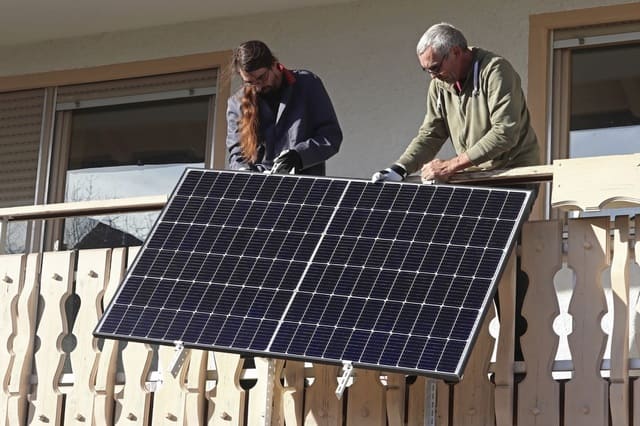
5. Installation of a small photovoltaic system by two people (Adobe Stock 583287211)


