



Hot Water Heat Pump without Storage Tank: 5 Advantages
Domestic hot water heat pumps are no longer an insider tip. More and more homeowners are relying on the efficient technology for hot water production. But one special design of this technology often causes raised eyebrows: the hot water heat pump without an integrated storage tank.
“How is that supposed to work?”, you might be thinking. After all, a heat pump is not an instantaneous water heater, but a device that heats hot water in reserve and therefore naturally needs a storage tank. But that is exactly where the clever part lies: This design relies on flexibility. Instead of installing storage tank and heat pump in one device, external storage tanks can be connected to these heat pumps, opening up entirely new possibilities.
Especially when renovating existing systems, in combination with renewable energies or when space is tight, this solution plays to its strengths.
In this article, you will find out how a hot water heat pump without its own storage tank works, in which cases it is particularly useful and what advantages it offers you. You will also get practical tips on planning and selection so that you can get the most out of your hot water system.
What is a hot water heat pump without a storage tank?
A classic domestic hot water heat pump actually always has its own hot water storage tank. It is designed as a compact system and takes care of heating the drinking water, and does so with very low electrical output. The stored heat is then available exactly when you need it.
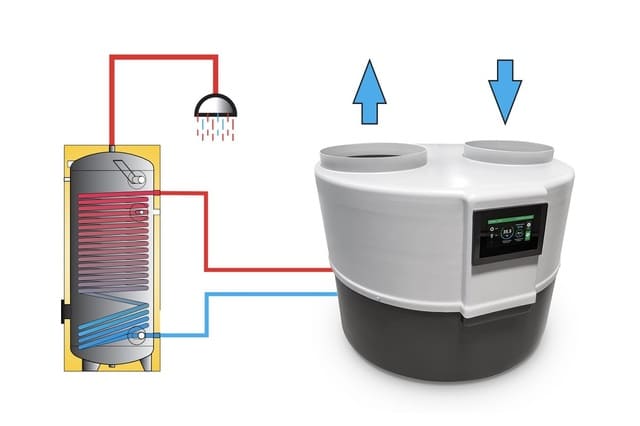
The storage-free variant takes a different approach. It focuses exclusively on heat generation and not on storage. Instead of combining everything in one housing, the heat pump is connected to an external storage tank.
This can be an existing hot water storage tank or a new storage tank. In the second case, you have direct influence over how large the storage tank should be and where it should be placed.
This separation brings more flexibility, both during installation and use.
At first glance, a heat pump without a storage tank seems incomplete. But this is exactly where the advantage lies: You use existing infrastructure or specifically choose the storage tank that suits your needs.
Do you already have a functioning hot water storage tank? Then you do not need to replace it. If you are planning a new system, you can precisely coordinate the storage tank size and heat pump output.
The design also gives you more freedom in placement. Without an integrated tank, the heat pump system is more compact. It fits into smaller technical rooms or can be integrated more easily into existing systems, for example during a renovation in which you want to separate hot water and heating in the future.
The operating principle remains the same: The heat pump for hot water extracts heat from the ambient air in the installation room and uses it to heat drinking water. It works like a refrigerator, only in reverse. Even at low outdoor temperatures, the air still provides enough energy. Only the installation room should not be smaller than 10 square metres.

Typical applications: When is doing without a storage tank worthwhile?
Connection to an existing hot water storage tank
In many single-family homes, hot water storage tanks are already installed in connection with the existing oil or gas central heating system. If this boiler is replaced or modernized, the storage tank often remains untouched. This is exactly where the storage-free domestic hot water heat pump shows its strength: It takes over hot water production and simply continues using the existing storage tank for this.
The advantage: You save yourself the investment in a new storage tank and still rely on modern heat pump technology. The heat pump only takes care of the domestic hot water, while the heating system runs separately. This is a good solution, especially for gradual modernization.
Combination with solar storage tank and photovoltaics
If you already have a solar thermal system, combining it with a hot water heat pump is particularly worthwhile. Hot water storage tanks for solar thermal systems, so-called solar storage tanks, often have several heat exchangers. One of these heat exchangers can be connected to the hot water heat pump.
On sunny days, the sun takes over the heating. If the solar energy is not sufficient, the heat pump kicks in. The whole thing becomes even more effective if you operate a photovoltaic system. Surplus electricity can be used directly for hot water production via the hot water heat pump.
Because the heat pump only needs very little electricity (a few hundred watts), a large share of the annual hot water can be provided through such a solution. This increases your self-consumption of PV electricity and lowers heating costs.
Cleverly using multivalent buffer systems
In larger heating systems in which several heat generators are combined (pellet boiler, solar thermal system, wood stove), a so-called multivalent buffer storage tank is usually used. In this case, a storage-free domestic hot water heat pump can heat the drinking water area in the storage tank.
This relieves the central heating system, reduces the running times of the other heat generators and achieves higher overall efficiency. The technology integrates seamlessly, and all without a complete conversion.

Compact solution when space in the house is limited
In many existing buildings, space in the technical room is limited, especially in smaller houses or angled floor plans. A compact heat pump with integrated storage tank needs a lot of floor space. The storage-free design, on the other hand, is significantly more space-saving. You can install the heat pump system in a small technical room or even in a niche. The hot water storage tank is placed where it fits better.
This is particularly practical in cramped basement rooms or if you want to use existing connections. This allows modern heat pump technology to be used even where there would otherwise be no space for a complete solution.
Gradual renovation and separate systems
You do not want to replace the entire heating system straight away? That is understandable, because it is expensive and laborious. With a separate hot water heat pump, you take a first step. You decouple hot water production from the old heating system and immediately increase efficiency. This is possible independently of the rest of the heating system.
This makes this solution ideal for owner-occupied homes that are to be modernized gradually. First, the hot water is converted, and only later is the heating addressed. This keeps the investment manageable and plannable.

5 advantages of the flexible design: How to get the best out of it
- Optimally matched storage tank size: Every household uses a different amount of hot water. The separate design allows you to use the existing storage tank or choose a suitable new one that matches your needs. This prevents oversizing and is maximally efficient. Whether a small household or a family of four with a morning shower bottleneck: You decide how much water is stored.
- Effective heat pump solution: A hot water heat pump without storage tank can be integrated precisely into your existing system. You combine modern heat pump technology with proven components. As a result, you work particularly efficiently, both in heat provision and electricity consumption. The technology adapts to your house, not the other way around.
- Simpler repair and maintenance: If a component fails, you do not have to replace the entire system right away. Separating storage tank and heat pump brings clear advantages in the event of repairs. You only replace the defective part, without unnecessary costs or lengthy conversions.
- Using existing infrastructure saves money: A well-insulated hot water storage tank is often still fully usable. So why replace it unnecessarily? With a storage-free solution, you use what is already there. This reduces not only the amount of material needed, but also the investment sum. Especially when renovating existing buildings, this is a major plus.
- Use subsidies for domestic hot water heat pumps: Even if no storage tank is integrated, many subsidy programmes still apply. Depending on the region and system, you can expect attractive grants, especially if you use the heat pump in combination with photovoltaics. This further relieves your budget and makes switching even more attractive.
Under the following links, however, you will find all current subsidies that are available:
- Subsidy overview specifically for heat pumps (German)
- Subsidy overview for residential building renovation (updated daily, German)
- Subsidy database with convenient search function (German)

Hot water heat pump: Who is it worthwhile for?
- Renovators with a limited budget: You want to modernize, but the money is not (yet) enough for a completely new heating system? Then a hot water heat pump without storage tank offers you an ideal entry point. You decouple hot water production from the old system and improve the efficiency of both systems.
- Households with specific hot water needs: Not everyone needs the same storage tank. With the storage-free solution, you adapt the storage tank size exactly to your everyday life, whether a single-person household or a family of four. The advantage: You only heat what you really need and avoid unnecessary energy losses.
- Combination with renewable energies: If you already use a solar thermal system or are thinking about a photovoltaic system, the hot water heat pump is the perfect partner. It supplements solar drinking water heating on cloudy days and uses PV surplus directly for hot water. This increases self-consumption and lowers costs at the same time.
- Use in buildings with a heating heat pump: Do you already have a heat pump in use for heating? Then you can outsource hot water production. Especially in transitional periods or when the heating load is low, it makes sense to operate hot water and heating separately, for greater efficiency and lower electricity consumption. At the same time, the noise emissions of the heating heat pump are reduced.
Overview of electricity consumption, costs and savings potential
How much electricity does a hot water heat pump consume per year? This depends mainly on the hot water demand and the efficiency of the device. In a four-person household, the average annual consumption is around 500 to 1,000 kWh.
By comparison: An electric instantaneous water heater consumes around three times as much for the same amount. The heat pump system also works significantly more economically than a heating boiler that simultaneously produces hot water.
The reason: It uses heat from the ambient air, even in winter. Only a small amount has to be supplied as electricity to bring the water up to temperature. This makes the technology not only efficient, but also predictable in consumption.
It becomes even more economical if you combine the heat pump with a photovoltaic system. Surplus solar power from the roof can be used excellently for hot water production.
This increases your self-consumption from photovoltaics and reduces electricity feed-in to the grid. Especially in the summer months, the system then runs almost self-sufficiently, with minimal operating costs.
Bottom line, you benefit twice: You lower ongoing energy costs and reduce your CO₂ emissions at the same time. Especially compared with fossil heating systems, this is a clear step toward the future.
Heat pump: What you should pay attention to when selecting and installing it
Before you decide on a hot water heat pump without storage tank, you should keep a few technical points in mind. The first is output. It must match your actual hot water demand.
A device that is too small runs constantly at full load; an oversized one consumes unnecessary energy. A specialist can help here, and can also check the hydraulic balancing of your system, an important efficiency factor especially in existing systems.
The choice of air source is equally crucial. The heat pump works most efficiently with exhaust air from indoor rooms such as a laundry room or basement. This air is usually warmer than the ambient air outside and therefore provides better conditions for heat exchange.
If indoor air is not available, outdoor air operation is also possible. In this case, make sure it is installed in a protected location to avoid performance losses in cold conditions.
The compatibility with the hot water storage tank also plays a central role. Not every storage tank is suitable for connection to a heat pump system. Suitable connections for the additional heating circuit and a sufficiently sized heat exchanger in the storage tank are important. If you are unsure, have the existing system checked by an installer.
A real advantage of modern heat pumps is their control system. Intelligent controls automatically adapt operation to your habits or use PV surplus electricity. Some models can even be integrated into smart home systems, for even more comfort and efficiency.
With the right planning, you get the maximum out of your system and ensure that the investment pays off for you in the long term.
Conclusion: A modern solution for your hot water system
A hot water heat pump without storage tank is not an emergency solution. It is a well-thought-out alternative for anyone who wants to modernize flexibly. It particularly plays to its strengths in existing buildings. You continue using existing technology, supplement it with efficient heat pump technology and thus create a system that fits your everyday life exactly.
The separation of heating and hot water not only gives you more freedom in planning. It often also increases efficiency. Because you only operate what you actually need. This lowers operating costs and makes your system future-proof.
If you want to save energy but cannot or do not want to convert your entire heating system immediately, the storage-free heat pump system offers you a sensible entry point. It works as an independent module that you can expand or adapt at any time, also in combination with renewable energies.
In short: You gain control, save energy and make your system more efficient step by step. A solution that is not only convincing today, but will still fit tomorrow.
Image sources:
1. Featured image: Hot water heat pump without storage tank (Canva Stock)
2. Hot water heat pump (Stiebel Eltron)
3. Ochsner mini solar storage tank (Adobe Stock)
4. Use subsidies for heat pumps (Adobe Stock)
5. Heat pump with external storage tank (Carsten Herbert)


